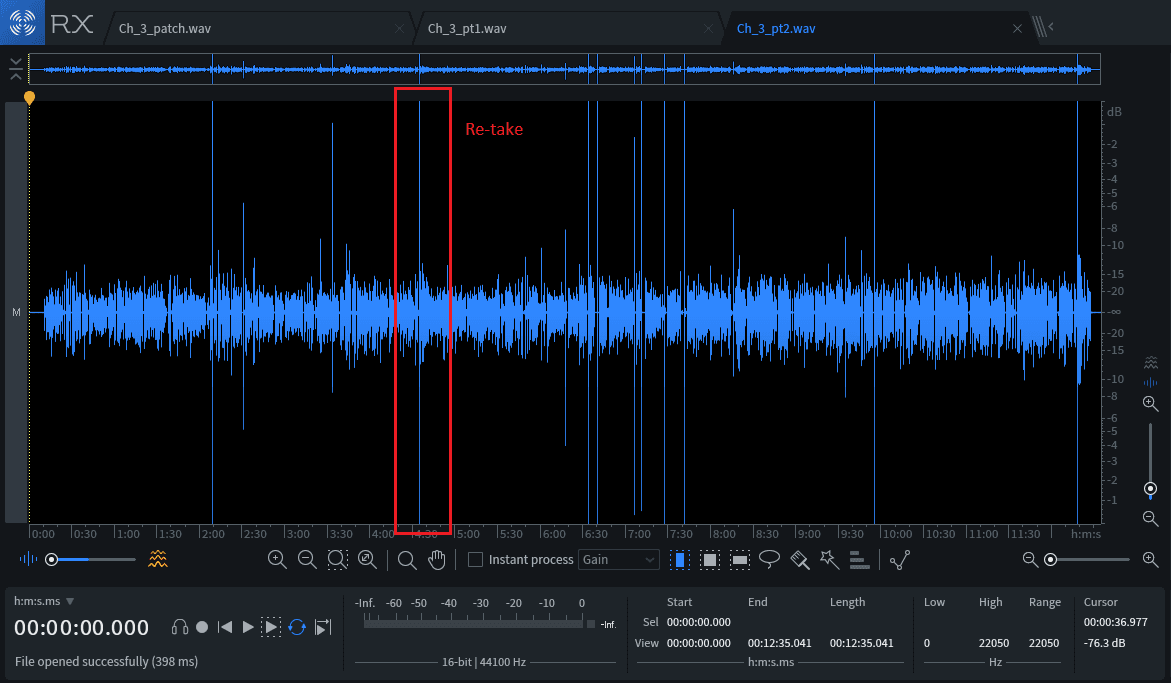
If you are an indie author narrating your own books, or a narrator collaborating with an audio engineer (and you prefer not to use “punch-and-roll” mode), please provide your engineer with clear sonic cues.
When you make a false start or an error — which is almost inevitable — make sure it’s clearly marked! You can cough, clap your hands, or use a clicker (check out the examples). Your engineer uses these sonic and visual cues to drastically speed up the editing process. If you pay your engineer on an hourly basis, this literally saves you money!
Couple of things to remember:
Make it loud: Your sonic cue should be significantly louder than your narration so the engineer can spot it instantly on the waveform.
The “Pause-Cue-Pause” Rule: Leave a short silence before and after the cue (e.g., Bad take — Pause — CUE — Pause — New take).
If you want your punch-ins to sound professionally, don’t miss this article. Simply be aware of that phenomenon and yeah — now take a look at the video below for a visual explanation. Those “spikes” are incredibly easy to spot, making the editing workflow much smoother and faster!
Common Concerns & Tips
Q: Do I need special equipment to make these sonic cues?
A: Not at all. A simple loud finger snap, a hand clap, or even a tongue click is enough. The goal is to create a sharp, visible vertical spike in the audio waveform that stands out from your speech.
Q: Can I just tell the engineer the time-stamps of my mistakes instead?
A: You can, but it’s much less efficient. Manually checking timestamps takes more time for the editor than simply “jumping” to visible spikes on the screen. Sonic cues automate the search process and, as a result, reduce your post-production costs.
Q: Won’t a loud clap hurt the recording or the microphone?
A: As long as you don’t clap directly against the microphone capsule, it’s perfectly safe. Just keep your hands 10–15 inches away from the mic when making the cue. It will create the necessary peak without any risk to the gear.
Q: What if I forget to make a cue immediately after a mistake?
A: Don’t worry and keep going. Just don’t forget to make it next time, okay..?
Q: Should I stop recording after making a cue?
A: No, stay in the flow! Just make the cue, pause for a second to catch your breath, and restart the sentence. Keeping the recording going helps maintain your natural vocal tone and energy.
Let’s Get in Touch
Well, I hope this helps! If you need an advice or assessment, or you want me to prepare your audiobook for publishing, please don’t hesitate to contact me.