Essential Checklist for Beginner Voice Actors

If you are recording outside of a professional studio, please keep these simple rules in mind to get the best possible results in your environment (especially if you plan to publish on major platforms like Audible). IMPORTANT: Points marked with this word are critical, but that doesn’t mean the others should be ignored! Let’s dive Read more…
How Sonic Cues Reduce Your Post-Production Costs

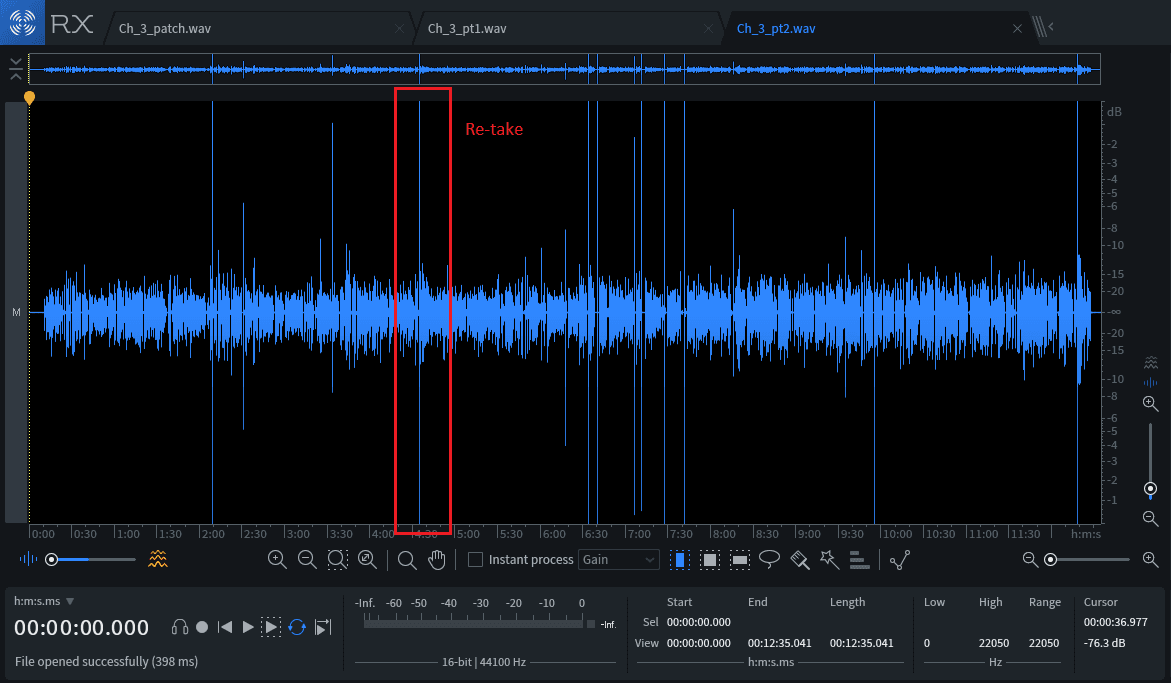
If you are an indie author narrating your own books, or a narrator collaborating with an audio engineer (and you prefer not to use “punch-and-roll” mode), please provide your engineer with clear sonic cues. When you make a false start or an error — which is almost inevitable — make sure it’s clearly marked! You Read more…

Can You Record a Professional Audiobook on a Smartphone?

Well… the short answer is yes, it can work. While I always recommend using a standalone condenser microphone, a pop filter, and a treated vocal booth, you can certainly start with your mobile device. However, it’s important to manage your expectations: a smartphone or a headset microphone won’t deliver “studio-grade” transparency right out of the Read more…

‘ACX check’ and ‘RMS normalization’ in Audacity

Hey, if you are a DIY person, but you don’t want to waste your time on figuring out plugin settings, check out this article first and download a go-to macro for Audacity. It’d be easier and faster! Okay, ACX-check plugin In a nutshell — what does it do? It checks if everything is technically okay. Read more…

The Essential Guide to Mastering Audiobook in Audacity

Are you an indie author narrating your own masterpiece? Or a voice talent looking to keep your production costs under control? If you’ve got a solid recording but want to skip the expense of professional mastering, you’re in the right place. I’ve put together a straightforward workflow to get your audio from “home recording” to Read more…

The Microphone Sounds Terrible. Why?

So, why your new shiny microphone sounds so awful? Turns out, this is a common problem, especially for beginners… and it’s easy to fix! Check out the software settings and pick your microphone! Most likely that’s the only reason. Wait… but how the sound is being captured then..? Your laptop has its own default mic, Read more…

Acoustic Treatment. Again..?!

Okay… just check this out. This is one of my favorite clients telling me about her struggle to find a quiet spot for recording during a weekend trip. And guess what? She found one! That’s true professionalism, resourcefulness, and persistence in action. I’m truly blessed to work with people like Jill.

TAT, Workflow and Pricing

Turnaround Let’s say, your book is being of around 10 recorded hours. If you need the full set of post-production (technical mastering, editing and proofing), then it can take 3…4 working hours per recorded hour. So, it’s going to be 30…40 working hours or 5…7 working days. Workflow Usual scenario entails four stages:— editing out Read more…

Turn OFF those “Enhancers” for Good (Your Audio Engineer Will Thank You)

If you’ve decided to record your audiobook using a laptop or a non-specialized microphone setup, it can work — but only if you follow this crucial rule: Disable every single built-in “audio enhancer” in your operating system and recording software. Designed for Calls, Not for Books Windows and macOS often come with pre-installed features like Read more…

Avoid The Common Mistake With Gain Staging

I see it more often than I’d like: clients send over audio files that are either teetering on the edge of distortion or are already “crunchy” and unusable. We’ve all heard that harsh, grating sound of a clipped signal. In 99% of cases, this isn’t due to bad luck — it’s a simple lack of Read more…

Audacity ACX Macro for RMS and Peaks

Hey there! Below, you will find two solutions to automate your technical mastering inside Audacity — ranging from a free basic fix to a custom-built setup. Option 1: The Free Standard ACX Macro (Download) This is your baseline “1-click button” to fix the two most critical technical reasons for ACX rejection: RMS Volume and Peak Read more…